The iPhone 13 is widely expected to come with Wi-Fi 6E capabilities, and while it may seem rather nuanced to the average consumer, with only improved speeds and being "up to date" in the realm of Wi-Fi technology, it's actually a fairly significant improvement, laying the groundwork for much of what we know the future holds.
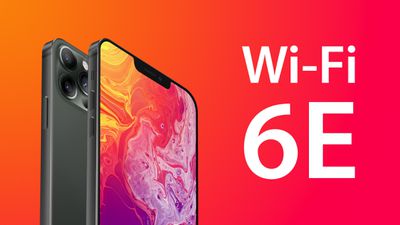
To truly understand Wi-Fi 6E, MacRumors sat down for an exclusive interview with Kevin Robinson, senior vice president of marketing for the Wi-Fi Alliance, to discuss the new generation of Wi-Fi, Wi-Fi's relationship with 5G, and what new experiences it will enable. The Wi-Fi Alliance is a group few have probably heard of, but as Kevin describes it, it's a crucial part of the Wi-Fi puzzle, consisting of a "who's who" in the connectivity space.
All of these companies come together with this common vision of connecting everyone in everything, everywhere. As I said, it really is the who's who in the connectivity space. And it includes everyone on the beat, from the core technology developers such as Qualcomm, Broadcom, Intel, etc. to the end product vendors such as Apple, Microsoft, Samsung, LG, and even service providers like Comcast, Charter, British Telecom, all find a home in Wi-Fi Alliance.
Wi-Fi is a technology that's present in the majority of technology products consumers buy and is one of the very few technologies itself that's universal. That universality means that all Wi-Fi devices must work together, even if from another brand or purchased in a completely different part of the world. That's where the Wi-Fi Alliance comes in with a program it calls Wi-Fi Certified. This program certifies devices for use with Wi-Fi, ensuring interoperability. In simpler words, the next time you go shopping for a router or other Wi-Fi-centric device and see a "Wi-Fi Certified" label, thank the Wi-Fi Alliance.
Traditionally, the name of every new release of a device, product, or technology includes a sequential increase in number, with the highest number being the latest and greatest. With Wi-Fi, that's only recently been the case. Before "Wi-Fi 6," Wi-Fi technologies were given names like 802.11b, n, or ax. The change to a sequential naming structure, according to Kevin, all boils down to making it easier for consumers to make the right decisions for their Wi-Fi needs.
Coming up with a generational naming approach was very critical in that it's very accessible and understandable to the average person who needs to know what is the latest Wi-Fi and for the industry to communicate what are the benefits associated with any given generation of Wi-Fi. There are characteristics, I think, that go along with each generation, and by having a very simple name, people are more likely to be able to associate those benefits with a given generation and ultimately make the best decision for them.
Knowing that, Wi-Fi 6 is still a fairly new technology. Released in 2019, it promises to offer users a more consistent, robust, and reliable Wi-Fi experience that works across a range of devices. Wi-Fi 6E, which on the surface is simply Wi-Fi 6 expanded into the 6-GHz range, was announced more recently in January of 2020.
Wi-Fi 6E builds on Wi-Fi 6, which includes a flexible approach to consumer Wi-Fi needs that ensures every device in a home, whether a smart TV streaming 4K content from Netflix or a small HomeKit-enabled sensor, gets the Wi-Fi performance that's right for that specific device.
Wi-Fi 6 is more deterministic, meaning you're getting a more consistent experience that works really well in dense environments. Because it's more efficient, it works well with multiple types of devices, all accessing the network at the same time and providing the level of service those devices need.
The biggest things are going to be high performance with multi-gigabit speeds that allow you to do things like stream high definition video, UHD video, mail with large file transfers, things like that. It delivers extremely low latency, which is something that's critical for gaming, where whether or not you have low latency determines whether it's maybe you losing the game or somebody else losing the game. But also critical for things like voice communications or VR where latency really feeds into the user experience and how you perceive VR.
Over the past year, Wi-Fi has skyrocketed in importance, with billions of people using it to live, work, and learn during the global health crisis. That increased reliance presented a challenge to Wi-Fi capacity, especially in densely populated areas. Wi-Fi 6E is designed specifically for this, where, thanks to the expansion into the 6-GHz range, the capacity of networks and routers has increased, along with performance.
Those additional benefits are an incredible increase in capacity. At a very high level, you have significantly more spectrum to operate with thanks to Wi-Fi 6E. You're going from one to maybe two 160 megahertz channels, and these are ultra-wide channels that allow very, very high performance. You get one or two of those in the five gigahertz band, depending on where you are. And you get up to seven of these super-wide channels in the 6-GHz band. It's critical when you're in, let's say, multi-dwelling units. Think of New York, Chicago and with high rise buildings around the planet; think of stadiums; that's where it becomes essential to have that additional capacity.
The bedrock of Wi-Fi 6E's creation is the realization that under previous technologies, there would not have been enough capacity for users. This similar realization is also a reason behind the rapid adoption of 5G, specifically 5G mmWave, which aims to deliver high performance in densely populated areas.
We were simply approaching a scenario where there would not have been enough spectrum and capacity for people to do everything they wanted to do, and what we envision happening over Wi-Fi. You would have been contending with your neighbor's network; even in a suburban setting, I see three, four, or five networks around me. Now, you take that into a dense city area and it becomes a much bigger problem. So it was essential for maintaining the experience over the long term of what you're gonna get from Wi-Fi 6E.
Even with the increased reliance on Wi-Fi, the significant jump in capacity presented by Wi-Fi 6E seems, to the average consumer, almost overkill. I asked Kevin why, let's say, a family of four would need to take advantage of Wi-Fi 6E when it may be excessive for their needs.
I think what often gets overlooked is that as people are in increasingly dense environments, even suburbia, you have smaller land plots between single-family homes, and as people are increasingly moving into more urbanized areas, it's not just about the performance, let's say, that your family of four needs. But also because you are sharing [Wi-Fi] on this unlicensed spectrum with those that are around you. By adding this additional spectrum of Wi-Fi 6E, it means that, if I'm in an apartment complex, I have people on all four sides of me, and I have similar people above and below me kind of on all four sides, all using a shared resource. So again, it's important to understand that you still benefit by having more spectrum capacity and that you are going to get the performance that the technology can support without contending as much with those around you.
The technologies inside of routers and supported products only write half the story, the other half comes from internet service providers. I asked Kevin where ISPs fall into this grander scheme of our Wi-Fi world. Specifically, why should users invest in Wi-Fi 6E compatible devices if their ISPs cannot take advantage of them?
Kevin tells me that ISPs play a "very active" role in the Wi-Fi Alliance and that service providers who are on the "leading edge" wanting to deliver the best possible experience for their customers will take advantage of Wi-Fi 6E and all it has to offer.
I ended our conversation with a rounded question about the thinking behind Wi-Fi as a whole. Current measurement metrics for an average user include whether a TV show buffers or how long it takes to download a movie. My curiosity resides in where that mentality will be in 10 to 15 years; what arbitrary unit of measurement will we use to classify Wi-Fi speeds in the future?
The answer is that many things will be the same; content streaming and so forth will stay around. However, Kevin's main point is that consumers won't be as concerned over speeds as they're concerned over experiences, specifically virtual reality. Kevin believes that we're heading towards a future where Wi-Fi plays a more integral role in the immersion of VR experiences, rather than a focus on purely offering users high-speeds.
"Oh, well, that I [downloaded] all my contents and all my files in a matter of seconds stuff. That's amazing, right?" But then it's also going to be in experiences that are not so much like, "Oh, this happened in a few seconds," but rather, this VR experience is completely immersive; it is as close to reality as I can imagine, it's responsive, even though the person I'm interacting with is on the other end of the country, or, I'm using a game and I again, just cannot distinguish it from reality. And all of those experiences are going to rely on very high-performance Wi-Fi.
To me, Wi-Fi 6E is fundamental long-term in two ways. More and more people are using smart home devices, and in the Apple world, HomeKit-enabled devices. In a bubble, a single home has smart home products with laptops, smartphones, and more. Wi-Fi 6, and more so Wi-Fi 6E, is future-proofing Wi-Fi for a wide range of current and future devices.
Secondly, Wi-Fi 6E and how it plays a role in VR and AR seems to be one of the clearest reasons Apple could bring it to the iPhone 13 later this fall. Apple builds on technologies it places into its products, and as the company continues its development on "Apple Glasses," the inclusion of Wi-Fi 6E and all of the benefits of high-speed, optimized, high-load Wi-Fi seems like a clear step in enabling future VR/AR experiences.