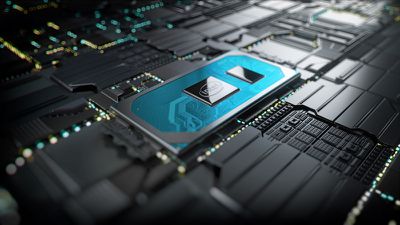
Intel says the Ice Lake chips have increased board integration, allowing manufacturers like Apple to release notebooks with sleeker designs. The chips also feature Intel's all-new Gen11 graphics architecture for up to double the graphics performance, and integrated Thunderbolt 3 and Wi-Fi 6, aka 802.11ax.
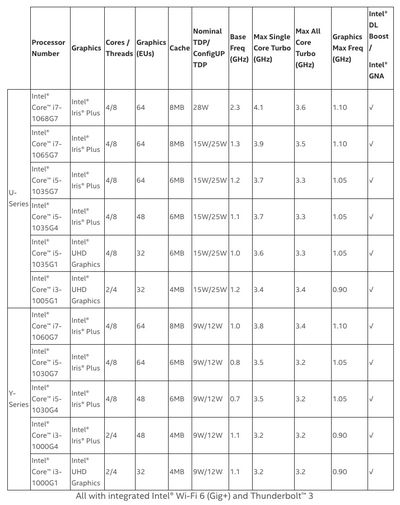
The lineup of 11 new processors includes six U-series chips and five Y-series chips:
Intel is also introducing a new processor number naming structure starting with this first set of 10th-generation Core processors, doing away with Y and U series identifiers and instead emphasizing graphics. The new structure is a bit confusing, but The Verge has a nice breakdown for deciphering them.
Intel expects the first notebooks with Ice Lake chips to be available in time for the holiday shopping season.
Sunday November 22, 2026 7:32 am PST by Joe Rossignol
Apple plans to unveil an iPhone 18e, iPhone 18, updated entry-level iPad, and new MacBook Neo and MacBook Air models around February or March next year, according to the latest word from Bloomberg's Mark Gurman.
In his Power On newsletter today, Gurman said Apple has some additional products planned for the first half of 2027, including the iPhone Air 2 and new iPad Air and iPad Pro models,...
Wednesday November 25, 2026 3:30 pm PST by Juli Clover
A MacBook Air with a new look could launch in late 2027 or 2028, Bloomberg's Mark Gurman said in the latest episode of his Power On podcast. Apple plans to refresh the MacBook Air with M6 chips in early 2027 alongside the MacBook Neo 2, but that update won't include a new design.
A more extensive overhaul could follow later in 2027 or in 2028, and the MacBook Air could get an OLED display at ...
LG Display is developing a new way to make OLED screens with higher brightness, longer lifespans, and lower power consumption for future Macs, according to The Elec.
The technology, called "FLiPP," is reportedly being developed for potential use in Apple's MacBook Air and iMac in 2030. LG unveiled it in August, but the latest report identifies the Apple products it could eventually reach.
...
This CPU line-up is probably as good a clue as any as to why the 12-inch MacBook was killed (for now). The 2015 MacBook launched with a 4.5W Y-series CPU. Last year's Y-series CPUs then went to 5-7W. Now we're at 9W. Apple designed a laptop based on the assumption — presumably promised as such by Intel — that Intel would keep iterating on a roughly 4.5W TDP CPU, and they failed to do so, even after this process shrink.
700MHz base clock. What decade century is it again?
This is good, actually. Low clock rates means Intel has some breathing room for future generations at the same process size to offer more performance simply by cranking up the clock rate.
Which TDPs are MacBook pro compatible? All of them?
9W: probably the MacBook Air (which is currently at 7W, but presumably Apple has learnt the lesson not to trust Intel on that).
15W: low-end 13-inch MacBook Pro.
28W: possibly the higher-end 13-inch MacBook Pro, but Apple probably wants more options for that. Also, this CPU model won't ship for a while.
Critically, none of these are even remotely an option for the 15-inch (16-inch?) MacBook Pro, which likely won't see another CPU upgrade until Comet Lake-H in Q2 2020. It'll offer up to ten cores, but it will still be at 14nm and still use a revised Skylake architecture. Still no LPDDR4, even.
Can't come soon enough the day that Apple can engineer some A-series chip and release upgrades when the Mac, not Intel, are ready. I could see the MacBook line getting resuscitated as a canary for this