Skip to Content

Patent Applications Reveal Apple's Research Into 3D Chip Packaging

Apple's persistent quest for better performance, longer battery life, and slimmer form factors appears to be driving its research into advanced chip packaging technologies. So-called "2.5D" and "3D" packaging methods stand to offer significant gains in all of these areas by increasing memory bandwidth, reducing power consumption, and freeing up space for higher-capacity batteries.

Apple has been an aggressive adopter of new device packaging methods, mostly thanks to integrated fan-out (InFO) innovations provided by foundry partner TSMC. TSMC's success has spurred it into further developing and diversifying its packaging offerings, and TSMC has emerged as an industry leader in packaging techniques.
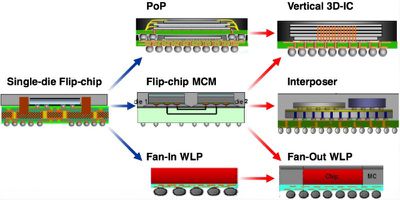
tsmc chip packaging
While versions of TSMC's InFO packaging have brought performance improvements to Apple devices, such as better thermal management and improved package height, it has largely not been a direct enabler of improved electrical performance. This is set to change with future packaging techniques and is already seen in some products that utilize interposers for higher density interconnects to on-package memory, such as High Bandwidth Memory (HBM).

The primary memory candidate for inclusion in such a package would be conforming to the Wide I/O set of standards described by JEDEC, and mentioned by name in several of the patents. This memory improves on LPDDR4 by increasing the number of channels and reducing the transfer speed per channel, thus increasing the overall bandwidth but lowering the energy required per bit.

Interposers do, however, pose several issues for mobile devices. Significantly, they introduce another vertical element to the package, increasing total height. Interposers must also be fabricated on silicon wafers just like active ICs, with their dimensions driven by the footprint of all devices that need to be included in the package. These solutions are typically termed as "2.5D" due to some components being placed laterally with respect to one another rather a true stacking of chips.

Rather than adopt interposers for its products as a next step in advanced packaging, the direction of Apple's focus, according to several patent applications [1][2][3][4], appears to be on true "3D" techniques, with logic die such as memory being placed directly on top of an active SoC. Additionally, a patent application from TSMC seems to suggest a level of coordination between Apple and TSMC in these efforts.
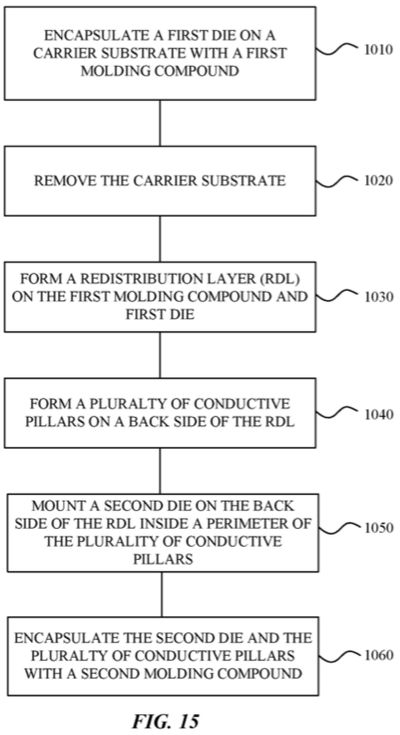
3D process

3D stacking process flow

The process has similarities to the existing InFO techniques in that they both involve a redistribution layer (RDL) where contacts on a logic die are routed inside a molding compound with the help of vias directly in the molding compound. Where the 3D process diverts from this is that there is now RDL content on both sides of the die, necessitating the use of through-silicon vias (TSV) directly in the logic die so that interconnections can be made with the top of the die. A key feature of these RDL layers is that interconnect pitches finer than available substrate or interposer types is possible.

Subsequent dies could then be attached to the molding compound, mating with the vias and RDL placed in the previous step. This step could be done multiple times, provided each stacked component has TSVs for the next level of integration, and this is already seen in HBM, which allows for the stacking of up to eight DRAM dies.
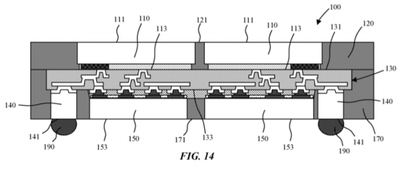
3D assembly

Side view of memory die (110) attached to SoC (150) in 3D package

Still, this approach has many technical challenges that have prevented its commercialization. TSVs are expensive to implement and are a serious yield detractor to ICs. Electrical isolation from nearby components' radiated energy can also be a concern, particularly when integrating RF and analog components in a package with other components that would have been separated by space and EMI shielding before. Apple describes techniques to incorporate shielding directly in the package to mitigate this.

Integrated EMI Shield

Package with integrated EMI shield

This approach also presents thermal challenges since active dies become so closely coupled in mediums that have poor thermal conductivity and shared thermal paths. These concerns extend not only to normal device usage, but also the package integration and any solder reflow steps. Thermal stresses can induce warpage of the packaging components due to differing coefficients of thermal expansion (CTE) amongst the materials utilized in the package. This warpage can lead to broken or separated contacts, resulting in device failure.

The use of a carrier substrate in the process flow mitigates some of the thermal concerns. The direct integration of heatsinks into device packaging is also addressed at various levels of the package assembly, such that higher dissipating die, such as a SoC featuring CPU and GPU cores, could be placed on the bottom of the stack or at a higher level of integration, providing stackup flexibility not seen in previous PoP arrangements.
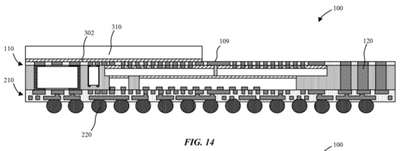
Integrated heatsink

Package with integrated heatsink component (310)

Embodiments may be applied in applications such as, and not limited to, low power and/or high I/O width memory architecture. Embodiments can enable a short double data rate (DDR) channel to neighboring function units (e.g. SOC, chipsets, etc.) by using RDL and direct chip attach. Embodiments may be particularly applicable for mobile applications that require low power DDR at target performance including high speed and I/O width.

The benefits of the methods described are many. The use of higher bandwidth memory will yield performance improvements. The flexibility of component placement shortens the distance between connected active and passive devices, either lowering the energy required to communicate between them, or reducing parasitic effects that can cause unwanted power loss or dynamic performance degradation. The most notable tasks that stand to benefit are gaming and image processing tasks, which often require large amounts of bandwidth over short time intervals.

Apple Watch Implications

These enhancements would be applicable to all of Apple's mobile devices, but multiple patent applications specifically mention methods of multiple components married together in a System in Package (SiP), as seen in the current Apple Watch. The methods described below are an enhancement on the existing SiP solutions found in Apple Watch in that they introduce true 3D stacking elements enabled by both TSV and Through Oxide Vias (TOV).
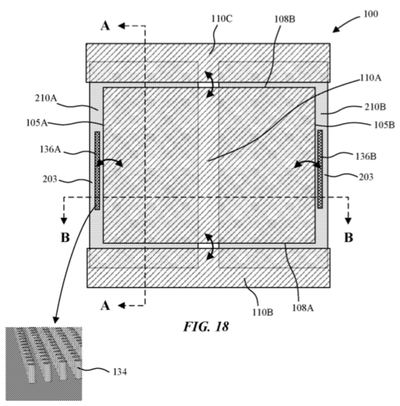
TOV array

Array of TOVs for connecting stacked die to package pins

In one aspect, embodiments describe system on chip (SoC) die portioning and/or die splitting within an SiP structure (e.g. 3D memory package) in which IP cores such as CPU, GPU, IO, DRAM, SRAM, cache, ESD, power management, and integrated passives may be freely segregated throughout the package, while also mitigating total z-height of the package.

Additionally, the patent describes TSV and TOV pitch in explicit detail, suggesting that keeping package heights down allows them to create very small width vias, with the TOV forming interconnect rows at sizes smaller than even the TSVs. The effect of TSVs stressing active parts of the die, including hurting transistor performance, is also discussed, and the reduced pitches help to mitigate this.
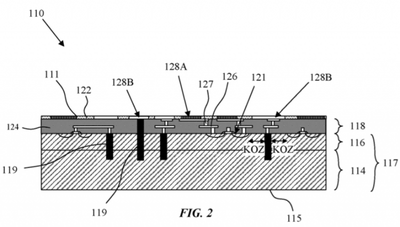
KOZ

Active die keepout zones around TSVs

Inclusion of RF transceivers and active devices on substrate types not currently used in Apple mobile devices are covered, indicating all types of active and passive components found in Apple Watch products could be housed in the SiP proposed.
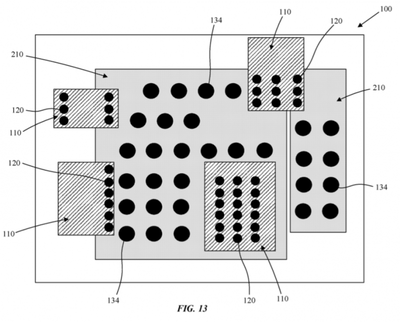
TLV hetero die

Bottom level view of an SiP with stacked heterogenous die interconnected with TSV and TOV

Timeline

Packages featuring 2.5D and 3D connected components have been in consumer devices for several years, but most of the methods described above have yet to debut in mobile devices. The steps described are set to increase manufacturing complexity, and cost and throughput will likely suffer as a result.

Due to cost and yield concerns, a primary candidate for first inclusion of these methods would be a high-margin, low-quantity device. While the iPhone is the highest margin of Apple's mobile products, it is also the largest volume category, with a huge initial demand for each generation. The iPad Pro is a good candidate because of its low volume nature and its classification as a high-performance device. The inclusion of 120Hz refresh rate is something that will benefit from increased memory bandwidth, specifically.

The focus of many of these patents seems to be specifically on SiP methods seen in Apple Watch internals. The Apple Watch is a lower-volume device, and it stands to benefit because its internals are extremely sensitive to package size given the importance of its form factor and battery size. It seems reasonable to expect some of the methods described to be incorporated as soon as the next revision of the Apple Watch, and more progressively in future revisions.


Related Roundup: Apple Watch 12
Tag: TSMC
Buyer's Guide: Apple Watch (Buy Now)
Related Forum: Apple Watch

Popular Stories

apple watch series 3 design

Apple Offers Steps to Fix Daylight Saving Time Bug on Apple Watch

Sunday November 1, 2026 3:34 am PST by
Apple has published a support document describing what to do if your Apple Watch continues to show time that's off by one hour after daylight savings time changes. "This incorrect time appears only on the Always On display when your wrist is down," says Apple. "When you activate the display by tapping it or raising your wrist, the time changes to the correct hour." To fix the issue, Apple says ...
muse apple watch app

Meta's Muse AI Agent Comes to Apple Watch

Monday November 9, 2026 1:55 pm PST by
Meta today updated the Muse app for iOS to add Apple Watch support, which means Muse users can access the proactive AI agent from the watch. The app adds the Muse character to the watch with an option to text it, dictate text to it, or call it. There's also a Muse complication for quick access. Muse is Meta's personal AI agent that can complete tasks for users. It is available as a...
siri recap live rewind

watchOS 27.3 Brings Live Rewind and Siri Recap to Apple Watch

Tuesday November 3, 2026 10:35 am PST by
With the first beta of watchOS 27.3, Apple is introducing new Audio Intelligence features it previewed for the Apple Watch Series 12 and Ultra 4 earlier this year. Powered by the S11 chip, Audio Intelligence includes Live Rewind, Siri Recap, Sound Recognition, and Shazam Music Recognition. Sound Recognition and Shazam are already on the watch, but Live Rewind and Siri Recap are now available ...

Top Rated Comments

slimtastic Avatar
110 months ago
That's cool. I have no idea what I just read. But that's cool.
Score: 7 Votes (Like | Disagree)
Mikey44 Avatar
110 months ago
Just want to say thank you to MacRumors for posting this in-depth article. I appreciate articles that take the time to actually explain the science behind the ideas that have been patented and helps raise the level of discourse here.

TL;DR I'm glad it's not all just Apple VS. Samsung!
Score: 3 Votes (Like | Disagree)
x-evil-x Avatar
110 months ago
Yet we have people saying this is a copy of another patent and the patent office will make a mistake granting this.
the 1%.
Score: 2 Votes (Like | Disagree)
FelixDerKater Avatar
110 months ago
Keep the R&D focus! That's where the future is.
Score: 2 Votes (Like | Disagree)
110 months ago
That's cool. I have no idea what I just read. But that's cool.
I understood integrated heatsinks into the chips themselves. That's all I understood.
Score: 1 Votes (Like | Disagree)
110 months ago
I'm really surprised these are patentable. I worked in microelectronics for the Gov't since the early 80's and National Semi, Fairchild, TI, and others all had ideas for stacked die, flipped chips, multiple die per package ICs, etc so not sure what's new and novel without digging into it I guess. Manufacturing wasn't up to the task back then and must be they never patented the ideas, or they expired.
What's being patented is not the vague idea of "wouldn't it be cool to stack chips on top of each other", it's a specific way of actually ACHIEVING that goal.

Reality is that these patents (I suspect) are not worth much, they're being filed just in case, as legal protection.
The HARD part is in the trade secrets of how to actually get the zillion steps of the process working, and most of that is either tacit knowledge or (of you're really lucky) written up in some ISO9001 documentation (which is, of course, company internal, not public).
[doublepost=1528837900][/doublepost]
One of it's primary purposes is to enable AAPL to better-support the the "concurrent capture" of Burst Photos AND Depth Data Maps.
Higher bandwidth yes, but also lower power. The closer you can bring DRAM to the SoC, the less power it takes to transfer each bit.
A second possibility (it will come, but the technology of the patent may not yet be good enough) is the construction of the SoC as two distinct layers, one on top of the other. The primary benefit of this is to reduce the length of some long distance wires. This can be done (has been in the academic literature) in such a way as to avoid placing hotspots on top of each other, so avoiding thermal issues. An easy example (which may actually be the first real implementation of the idea) might be something like moving the L3 cache to a second physical layer, living between the logic at the bottom and the DRAM above. The tricky part is you now need metallization on both sides of the L3...

There's a great discussion of this technology's past and future here:
https://community.arm.com/arm-research/b/articles/posts/three-dimensions-in-3dic---part-iii
Score: 1 Votes (Like | Disagree)
Latest Stories
The 50+ Best Apple Black Friday Deals on AirPods, iPads, MacBooks, and More
2 hours ago
iPhone 18 Production Delay Leaves Apple Little Time Before Launch
22 minutes ago
The Best Black Friday AirPods Deals
55 minutes ago
The Best Black Friday Deals on Apple Home Products
59 minutes ago
The Best Black Friday iPhone Deals
1 hour ago
The Best Black Friday iPad Deals
1 hour ago
The Best Black Friday Apple Watch Deals
1 hour ago
The Best Black Friday AirTag Deals
1 hour ago
The Best Black Friday Mac Deals
2 hours ago
iPhone Share of US Smartphone Market Hits 57% as Rivals Slip
2 hours ago
iPhone 20 Pro Rumored to Feature 3D-Printed Titanium Frame
4 hours ago
Apple's Official 2026 Black Friday Offer Starts Rolling Out
22 hours ago
Halide Adds Fill Light Feature for iPhone Duo
22 hours ago
MacBook Air Black Friday Deals Now Live With Massive $399 Savings
23 hours ago
Amazon Discounts All MacBook Neo Models by $99 for Black Friday
23 hours ago
Kodak Launches Unique AirTag Rival With E-Ink Display
1 day ago
Here's Why the Apple Store is Going Down
1 day ago
Apple Still Working on Giant Foldable iPad That Could Cost $5,000
1 day ago
iPhones Dominate China's Weak Singles' Day Smartphone Sales
1 day ago
iPhone 20 Pro Could Feature Ceramic in Limited-Edition Model
1 day ago
Apple Faces Korean Regulator Review Over iPhone 16 AI Advertising
1 day ago
Apple Watch Ultra 4 Hits New Best-Ever Price of $649.99 for Black Friday
1 day ago
New Apple Store Opening in India, Download the Special Wallpaper Now
1 day ago
Redesigned OLED MacBook Air Could Launch in 2027 or 2028
2 days ago
AirPods Pro 3 for $149 is One of The Best Black Friday Deals This Year
2 days ago
1Password Security Breach: What Was Accessed and What Wasn't
2 days ago
WhatsApp Finally Adds Scheduled Messages
2 days ago
Get Apple's Cheapest iPad for $379 During Amazon's Black Friday Sale
2 days ago
Rumor: iOS 28 to Revamp Notifications
2 days ago
iPhone 18 Pro Max Battery Exhausts a Toy Cyclops in New Apple Ad
2 days ago
Related Apple News: Sport | Mac | Technology | News | Iphone