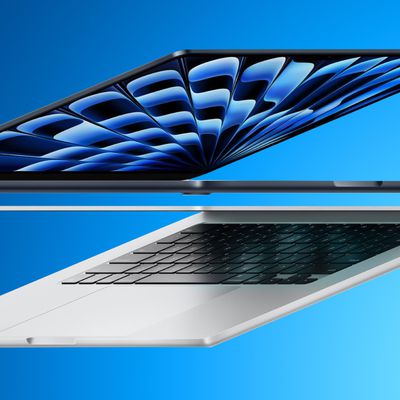
Haswell-Based MacBook Airs See Minor Speed Boosts Alongside Battery Life Focus
With the introduction of its new Haswell-based MacBook Air models yesterday, Apple revealed a strong emphasis on battery life, pushing the rated operating time from five hours to nine hours on the 11-inch model and from seven hours to 12 hours on the 13-inch model.
Even with the focus on battery life, Apple was also able to bring some minor performance improvements, as seen in Geekbench 2 benchmarking results highlighted by Primate Labs. Overall, the new MacBook Air models performed 3-8% better than their previous-generation counterparts.
With Haswell, Intel's focus was on reducing power usage. Rather than improve performance by 25%, Intel improved performance by 10% while consuming 25% less power.
Apple then went a step further. Apple reduced power usage even more by selecting processors with lower frequencies. In the low-end Air, the frequency has been reduced to 1.3 GHz from 1.7 GHz, while in the high-end Air, the frequency has been reduced to 1.7 GHz from 2.0 GHz.

The new MacBook Air is available now through Apple's online store, although the company recommends waiting until tomorrow before trying to obtain one at any of its retail stores. Pricing begins at $999 for the 11-inch models, with the 13-inch models starting at $1099.
Popular Stories
Apple plans to unveil an iPhone 18e, iPhone 18, updated entry-level iPad, and new MacBook Neo and MacBook Air models around February or March next year, according to the latest word from Bloomberg's Mark Gurman.
In his Power On newsletter today, Gurman said Apple has some additional products planned for the first half of 2027, including the iPhone Air 2 and new iPad Air and iPad Pro models,...
A MacBook Air with a new look could launch in late 2027 or 2028, Bloomberg's Mark Gurman said in the latest episode of his Power On podcast. Apple plans to refresh the MacBook Air with M6 chips in early 2027 alongside the MacBook Neo 2, but that update won't include a new design.
A more extensive overhaul could follow later in 2027 or in 2028, and the MacBook Air could get an OLED display at ...
LG Display is developing a new way to make OLED screens with higher brightness, longer lifespans, and lower power consumption for future Macs, according to The Elec.
The technology, called "FLiPP," is reportedly being developed for potential use in Apple's MacBook Air and iMac in 2030. LG unveiled it in August, but the latest report identifies the Apple products it could eventually reach.
...