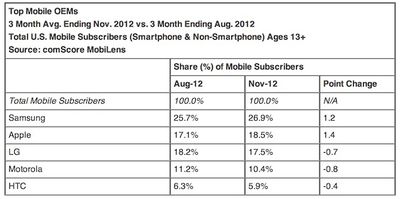
comScore today released the results of its monthly rolling survey of U.S. mobile phone users for the September-November period, finding that 18.5% of U.S. mobile phone subscribers are now using an iPhone, up 1.4 percentage points from the June-August period. Samsung continues to lead the market at 26.9% on 1.2 percentage point growth, while the remainder of the top five vendors all lost share.
Apple overtook LG for the second spot in last month's survey, and solidified its lead in the latest data on continued growth paired with a small decline by LG.
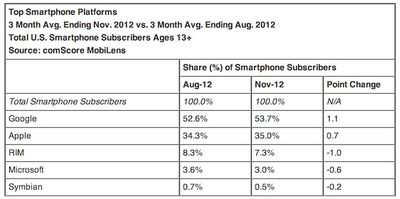
In looking only at smartphones, which now account for 53% of the U.S. mobile market, Android has continued to expand its lead and now holds 53.7% of the market. The iPhone 5 launch has, however, allowed Apple to continue its growth and the company now holds 35% of the smartphone market as the fall of RIM and Microsoft have increasingly turned the smartphone market into a two-horse race.
Notably, comScore's data tracks installed user base rather than new handset sales, making it more reflective of real-world usage but slower to respond to shifting market trends than some other studies.
As we wait for WWDC to kick off next Monday, Apple today announced the winners of its annual Apple Design Awards, recognizing apps and games for their innovation, ingenuity, and technical achievement.
The 2025 Apple Design Award winners are listed below, with one app and one game selected per category:
Delight and Fun - CapWords (App) and Balatro (Game)
Innovation - Play (App) and PBJ -...
Thursday November 26, 2026 8:37 am PST by Joe Rossignol
Apple's annual four-day Black Friday through Cyber Monday shopping event is now live in Australia, New Zealand, and Thailand, and it will continue to roll out across Europe, the U.S., and Canada as the calendar turns to Friday, November 27 around the world.
In the U.S., Apple's terms and conditions say the promotion begins on November 27 at 12 a.m. Pacific Time and ends on November 30 at...
Wednesday November 25, 2026 1:09 pm PST by Juli Clover
Popular password management app 1Password today said it experienced a security breach earlier this month. 1Password says some customer names and email addresses were accessed, but no customer vault contents were compromised.
On November 19, 1Password saw indications that an employee's GitHub account had been breached and began investigating. The company says the breached GitHub account was...
Apple wants a triopoly. The issue isn't the handset, it's the ecosystem. It was the windows ecosystem, not windows that took down apple in the 90s (and just a little bit of anti-competitive practices).
'Divide and conquer' is what Apple wants, as well as extending the ecosystem beyond a handset to computer, tablet and TV is. Google/Android is less an issue in the fragmentation of handsets specs OEM and carrier add-ons. However Samsung is capable of taking on Apple directly, and Google with Motorola could if actually make a plan.
Apple wants an Amazon or a Windows/Nokia/Surface/xBox solution that dilutes the Samsung and Google threat. Apple is quite happy competing in a world where it gets the high spend 25% of the market, because no one can compete with it's efficiencies. If Samsung was unchallenged, it could attack the high end by subsidizing it with the (slightly less) low end, and have the mass to shift the power center of the 'mobile ecosystem' to itself. But with a bevy of competitors at the low end of a triopoly or greater space, no one ecosystem can establish that broad base lever point to lock in the long term.
In other words... sucky cheap phones/pads/computers drive customers to change, not upgrade to less sucky. Apple wants to be that change.
The more the better for consumers, it's competition that forces companies to better themselves.
Agreed. An example is the iPad Mini. Would probably not exist if it weren't for competitors in the marketplace - even Eddie Cue's email illustrates that.
That's a lot lower than I thought... Most anyone I see walking around on their phone has an iPhone.
That's because iPhones are consistent and recognizable, while Android phones are all just clumped together and no one knows the difference at first glance.
It's part of what makes these "ANDROID has more marketshare than iPhone!!!1!" articles all the more misleading.