Skip to Content

OWC Announces 6Gbps SSD Upgrade for 2011 MacBook Air

by

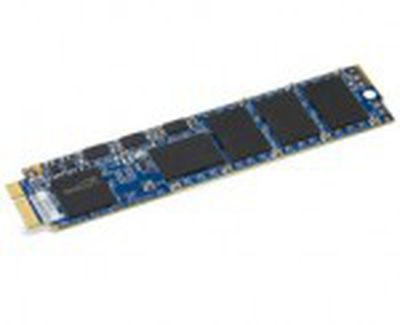
prod merc aura pro express6gOther World Computing, which offers many customization and upgrade options for Macs, today released an SSD upgrade for 2011 MacBook Airs that takes advantage of the MBA's SATA Revision 3.0 abilities and offers 6 Gigabits of potential throughput.

The factory SSD from Apple only supports SATA Revision 2.0, which maxes out at 3 Gbps, half the speed of Revision 3.0.

The new OWC Mercury Aura Pro Express 6G SSDs combine award-winning SandForce technologies and Tier 1/Grade A Toggle Synchronous NAND to deliver data rates that are more than 3x faster and capacities that are up to 4x greater than factory available SSD options. Currently available in two sizes–120GB and 240GB–the new 6Gb/s SATA 3.0 Revision models continue OWC’s position as the only alternative to factory SSD options for the 2010-2011 MacBook Air.

The upgrades don't come cheap, however. The 120GB version is $349.99 and the 240GB version is $599.99.

The MacBook Air comes standard with 64GB, 128GB or 256GB of storage.
Top Rated Comments

198 months ago
How ironic that your own comment is "ill informed." From the OWC Blog itself...

"Wear Leveling technologies are able to eliminate virtually any reduction in data transfer speeds over heavy, long-term usage without dependency on less-than-effective OS TRIM management."

Read it yourself here:
http://blog.macsales.com/11900-owc-announces-mercury-aura-pro-express-6g-industrys-first-6gbs-solid-state-drives-for-2011-apple-macbook-air

Huh? I think you misunderstand my post. The blog says:

"Utilizing SandForce DuraClass technology".

Therefore my statement was correct. These drives use the SandForce controller, so have their own 'housekeeping' mechanisms, so TRIM is not required to maintain performance.
Score: 3 Votes (Like | Disagree)
198 months ago
What worries me about these SSD 6G drives is the power consumption spec.
Active 3W & Idle 1.2W. This I believe compares to less than .5W for idle for the stock SSD. In other words, these SSDs will drain your battery pretty quick!
Score: 3 Votes (Like | Disagree)
198 months ago
I hate to break up the SandForce love train, but these claims are simply not true. While wear-leveing is important in the long run, in the short run it is not what causes SSD's to slow down, and claiming that the SandForce controller's garbage collection is on par with TRIM is simply wrong.

An SSD cannot overwrite a block with data, and therefore needs to empty it before new data can be written to the block. Because of how SSD's can write to the smaller pages but can only erase blocks, the "overwrite" process involves copying all relevant pages from an old block to a new block and then filling out the rest of the blank pages in a block. This is a slow process, and is best done during idle, instead of on-demand during a write, so the industry needed to come up with a solution to this and the answer was TRIM.

This whole problem arises because of the way traditional magnetic media worked: it had no overwrite penalty, so when something was deleted, the only thing that happened was that it's entry was removed from the directory (a pointer to its actual location) while the actual bits of data were left untouched sitting in whichever block they were residing in. Again, with no overwrite penalty for magnetic media, this worked great because you could just overwrite the block when the time came and nobody was the wiser. Since this isn't true for SSD's, TRIM came along to manually clear out blank pages/blocks and consolidate what was left for faster performance. The HUGE benefit of TRIM is that OS knows which allocated pages/blocks are still being used and which can be discarded, since it is in control of file management and knows what's been deleted and what hasn't been.

SandForce and it's ilk arose because both Apple and Microsoft were a little slow implementing TRIM support in their OS's and people wanted to use SSD's in their computers as soon as they were available without waiting for Lion or Windows 7, so HD-based "garbage collection" arose as a stopgap. The problem with it is that the HD can't know which allocated blocks are still in use and which aren't, so it only does it's best to consolidate all active pages and hope for the best. You'll notice the decreased long-term optimization of SandForce when you are running a mostly full drive, because it won't have as much space to get lucky with. This is why SandForce drives come with "scratch" areas pre-cordoned off (i.e. reported capacity of 240GB despite having 256GB), because it uses that extra area for write operations and then performs a deletes what is has now learned is an inactive page/block.

SandForce puts a lot of marketing into their controller, and it is pretty fast, partly because it does a lot of compression of your data when it can (which worries me a little bit anyway when using it with a non-integrity checking file system like HFS+). But nearly full drives that are TRIM-compatible are going to stay quicker throughout the life of the drive, while others will not simply because they can't know as much about what they are trying to organize as an OS-based routine like TRIM will.

And you don't necessarily want to pay for space on your drive which you can't use: this means you're losing about 7% capacity on top of the 7% you need to leave free for the OS's maintenance routines (like on-the-fly defragging, which is also part of at least Apple's TRIM implementation, so it's actually more efficient to do both at the same time anyway). With TRIM enabled, you can reuse the scratch space for both tasks, since the OS can see both, but not with SandForce.


This is mostly a marketing claim, because Sandforce is quicker at doing the easy garbage collection that it is capable of, while it's a longer route with more components involved for the OS to get the easy consolidation commands out of the way. Thus, more efficiency means slightly faster operations with only one component involved. Conversely, the SandForce controller is incapable of doing all the things that TRIM does, but I guess you could argue that doing less is also more efficient in the short-run.


Also, there are those failure rates. If you look up the Vertex 2 reviews on any site, you'll see nothing but complaints about their failure rates, enough so that OCZ listed increased reliability as a feature of the Vertex 3 (which uses a newer generation of the SandForce controller). Is your data something you want to trust to marketing promises, especially when combined with all the aforementioned data compression going on?

aristokrat:

Thanks for your great post.
Over the last year or so I pretty much read everything you mention (in various articles, online tests, blogs, etc). Nice to see it summarized.
My only non-technical comment would be, that regardless of the "shortcomings" the SandForce controller may have, if you want a 6G SSD in you 2011 MBA now, there is no other choice!?
Also unless someone has a convincing technical arguments, I would agree that TRIM is the way to go....
Score: 1 Votes (Like | Disagree)
198 months ago
These drives use the SandForce controller, so have their own 'housekeeping' mechanisms, so TRIM is not required to maintain performance.
I hate to break up the SandForce love train, but these claims are simply not true. While wear-leveing is important in the long run, in the short run it is not what causes SSD's to slow down, and claiming that the SandForce controller's garbage collection is on par with TRIM is simply wrong.

An SSD cannot overwrite a block with data, and therefore needs to empty it before new data can be written to the block. Because of how SSD's can write to the smaller pages but can only erase blocks, the "overwrite" process involves copying all relevant pages from an old block to a new block and then filling out the rest of the blank pages in a block. This is a slow process, and is best done during idle, instead of on-demand during a write, so the industry needed to come up with a solution to this and the answer was TRIM.

This whole problem arises because of the way traditional magnetic media worked: it had no overwrite penalty, so when something was deleted, the only thing that happened was that it's entry was removed from the directory (a pointer to its actual location) while the actual bits of data were left untouched sitting in whichever block they were residing in. Again, with no overwrite penalty for magnetic media, this worked great because you could just overwrite the block when the time came and nobody was the wiser. Since this isn't true for SSD's, TRIM came along to manually clear out blank pages/blocks and consolidate what was left for faster performance. The HUGE benefit of TRIM is that OS knows which allocated pages/blocks are still being used and which can be discarded, since it is in control of file management and knows what's been deleted and what hasn't been.

SandForce and it's ilk arose because both Apple and Microsoft were a little slow implementing TRIM support in their OS's and people wanted to use SSD's in their computers as soon as they were available without waiting for Lion or Windows 7, so HD-based "garbage collection" arose as a stopgap. The problem with it is that the HD can't know which allocated blocks are still in use and which aren't, so it only does it's best to consolidate all active pages and hope for the best. You'll notice the decreased long-term optimization of SandForce when you are running a mostly full drive, because it won't have as much space to get lucky with. This is why SandForce drives come with "scratch" areas pre-cordoned off (i.e. reported capacity of 240GB despite having 256GB), because it uses that extra area for write operations and then performs a deletes what is has now learned is an inactive page/block.

SandForce puts a lot of marketing into their controller, and it is pretty fast, partly because it does a lot of compression of your data when it can (which worries me a little bit anyway when using it with a non-integrity checking file system like HFS+). But nearly full drives that are TRIM-compatible are going to stay quicker throughout the life of the drive, while others will not simply because they can't know as much about what they are trying to organize as an OS-based routine like TRIM will.

And you don't necessarily want to pay for space on your drive which you can't use: this means you're losing about 7% capacity on top of the 7% you need to leave free for the OS's maintenance routines (like on-the-fly defragging, which is also part of at least Apple's TRIM implementation, so it's actually more efficient to do both at the same time anyway). With TRIM enabled, you can reuse the scratch space for both tasks, since the OS can see both, but not with SandForce.

The question at this stage is, just how much more efficient is the clean-up algorithms of the SandForce chip versus OS-based TRIM?
This is mostly a marketing claim, because Sandforce is quicker at doing the easy garbage collection that it is capable of, while it's a longer route with more components involved for the OS to get the easy consolidation commands out of the way. Thus, more efficiency means slightly faster operations with only one component involved. Conversely, the SandForce controller is incapable of doing all the things that TRIM does, but I guess you could argue that doing less is also more efficient in the short-run.


Also, there are those failure rates. If you look up the Vertex 2 reviews on any site, you'll see nothing but complaints about their failure rates, enough so that OCZ listed increased reliability as a feature of the Vertex 3 (which uses a newer generation of the SandForce controller). Is your data something you want to trust to marketing promises, especially when combined with all the aforementioned data compression going on?
Score: 1 Votes (Like | Disagree)
cluthz Avatar
198 months ago
It's good that there is an aftermarket alternative to the Apple SSD,
but am I the only one that feel the standard SSD is the only thing in the MBA that isn't a bottle neck?
Score: 1 Votes (Like | Disagree)
FloatingBones Avatar
198 months ago
What worries me about these SSD 6G drives is the power consumption spec. Active 3W & Idle 1.2W. This I believe compares to less than .5W for idle for the stock SSD. In other words, these SSDs will drain your battery pretty quick!

I asked OWC to comment on the impact their high-performance SSD would have on battery life. Look on their blog for a response -- hopefully tomorrow.
Score: 1 Votes (Like | Disagree)

Popular Stories

apple design award 2025

Apple Announces 2025 Design Award Winners Ahead of WWDC 2025

Tuesday June 3, 2025 10:14 am PDT by
As we wait for WWDC to kick off next Monday, Apple today announced the winners of its annual Apple Design Awards, recognizing apps and games for their innovation, ingenuity, and technical achievement. The 2025 Apple Design Award winners are listed below, with one app and one game selected per category: Delight and Fun - CapWords (App) and Balatro (Game) Innovation - Play (App) and PBJ -...
Apple 2026 Black Friday Event Hero

Apple's Official 2026 Black Friday Offer Starts Rolling Out

Thursday November 26, 2026 8:37 am PST by
Apple's annual four-day Black Friday through Cyber Monday shopping event is now live in Australia, New Zealand, and Thailand, and it will continue to roll out across Europe, the U.S., and Canada as the calendar turns to Friday, November 27 around the world. In the U.S., Apple's terms and conditions say the promotion begins on November 27 at 12 a.m. Pacific Time and ends on November 30 at...
1password deal blue

1Password Security Breach: What Was Accessed and What Wasn't

Wednesday November 25, 2026 1:09 pm PST by
Popular password management app 1Password today said it experienced a security breach earlier this month. 1Password says some customer names and email addresses were accessed, but no customer vault contents were compromised. On November 19, 1Password saw indications that an employee's GitHub account had been breached and began investigating. The company says the breached GitHub account was...
Latest Stories
The 50+ Best Apple Black Friday Deals Still Available on AirPods, iPads, and More
4 hours ago
Here Are the Best Apple Black Friday Leftover Deals You Can Get Today
3 hours ago
HomePod Mini 2 in (RED) Seemingly Spotted Ahead of Announcement
14 hours ago
Apple's M6 and PROLED MacBook Pro Reach New Low Prices for Black Friday
1 day ago
The MacRumors Show: iPhone Air 2 and iPhone 18 Are Coming
1 day ago
Apple Store in Brisbane Reopening Next Month With New Design
1 day ago
The 60+ Best Black Friday Accessory Deals on iPhone Chargers, TVs, Headphones, and More
3 hours ago
GTA VI Now (Barely) Running on Apple Silicon Macs
1 day ago
The Best Black Friday Streaming Deals on Apple TV, Disney+, and More
1 day ago
Apple TV's 'Carême' Wins International Emmy for Best Drama
1 day ago
iPhone 18 Production Delay Leaves Apple Little Time Before Launch
1 day ago
The Best Black Friday AirPods Deals Still Available
21 hours ago
The Best Black Friday Deals on Apple Home Products
1 day ago
The Best Black Friday iPhone Deals Still Available
21 hours ago
The Best Black Friday iPad Deals Still Available
20 hours ago
The Best Black Friday Apple Watch Deals Still Available
20 hours ago
The Best Black Friday AirTag Deals Still Available
20 hours ago
The Best Black Friday Mac Deals Still Available
20 hours ago
iPhone Share of US Smartphone Market Hits 57% as Rivals Slip
1 day ago
iPhone 20 Pro Rumored to Feature 3D-Printed Titanium Frame
1 day ago
Apple's Official 2026 Black Friday Offer Starts Rolling Out
2 days ago
Halide Adds Fill Light Feature for iPhone Duo
2 days ago
MacBook Air Black Friday Deals Now Live With Massive $399 Savings
2 days ago
Amazon Discounts All MacBook Neo Models by $99 for Black Friday
2 days ago
Kodak Launches Unique AirTag Rival With E-Ink Display
2 days ago
Here's Why the Apple Store is Going Down
2 days ago
Apple Still Working on Giant Foldable iPad That Could Cost $5,000
2 days ago
iPhones Dominate China's Weak Singles' Day Smartphone Sales
2 days ago
iPhone 20 Pro Could Feature Ceramic in Limited-Edition Model
2 days ago
Apple Faces Korean Regulator Review Over iPhone 16 AI Advertising
2 days ago
Related Apple News: Apple Watch Music Recognition Shazam | Caldigit Ts5 Element 5 | Black Friday | Iphone Duo App Launch On Open | Iphone Duo 20 Tips Apple Foldable